Village, Town or Hamlet: What the Labels Suggest
Village, town or hamlet labels offer a quick reading of settlement form and scale; learn how to compare them without mistaking a name for a definition.
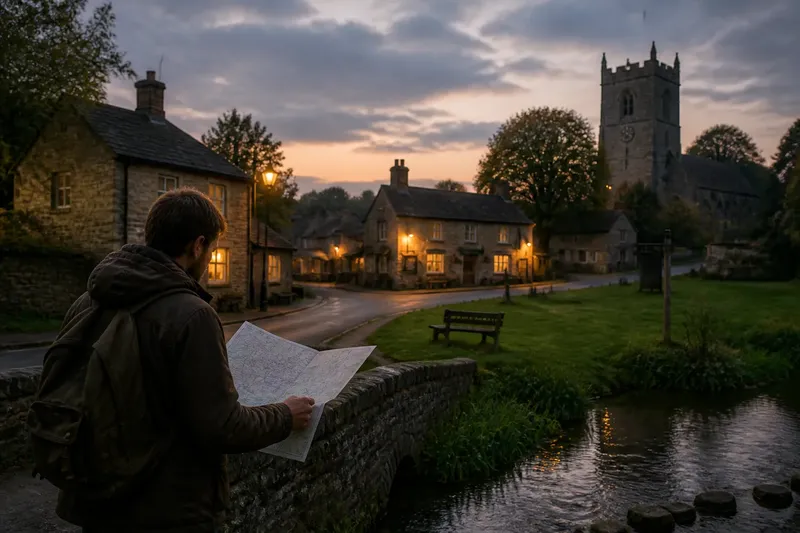
At a county map, a village may sit beside a busy road while a town appears as a cluster of streets around a green. The labels village, town and hamlet offer a first impression of settlement form and scale, but they do not settle what a place is. To read them well, start with the evidence on the ground and treat the word as a clue, not a verdict.
Start with the map
Find the place on a county map, then look beyond its printed label. Check the shape of the built-up area, the roads that reach it, and whether nearby settlement appears continuous or separated by open land. An Ordnance Survey map, a county council map, or a current street map can provide different levels of detail.
Do not begin by counting buildings. Map symbols and scale can make a compact group look larger or smaller than it is, while a place may include outlying farms or newer housing that the name does not capture. First note the broad pattern: isolated cluster, compact core, or a more extensive spread of streets and services.
Read the settlement form
A hamlet commonly suggests a small, close-knit group of homes, often without the range of services associated with a larger center. It might sit at a road junction, beside a stream, or near a larger village. The term points toward modest scale, not a fixed building count or a universal administrative status.
A village often suggests a recognizable local center with homes and some shared amenities. A church, school, pub, village hall, or small shop may contribute to that impression, though none is required everywhere. Some villages are strung along a road; others gather around a green or crossroads.
A town usually suggests a larger and more varied settlement, with a broader center and services used by people from surrounding places. Shops, civic buildings, bus links, and a denser street network may be visible clues. Yet a town can have a small population or a compact footprint, and the label may persist even as its role changes.
These are ordinary associations, not a ladder that every place must climb. A village can feel busier than a small town on market day, and a hamlet can have a prominent landmark without becoming a town. Form and scale help describe a settlement; they do not rank its importance.
Compare the local role
Next, ask what the place does for the area around it. Does it provide everyday services to nearby residents, or do people generally travel elsewhere for them? Is there a central street or meeting place, and do roads converge there? These questions reveal a settlement’s local role more usefully than the label alone.
Use a current map or local directory to identify services, but distinguish a destination from a center. A petrol station on a bypass may serve many travelers without making the nearby settlement a town. Conversely, a village with a school and hall may anchor local routines even if its commercial center is slight.
Say you are comparing two places on a county map. One is a tight cluster with a pub and a church; the other has a longer row of homes, a shop, and a bus connection to nearby villages. You might describe the first as hamlet-like and the second as village-like, while checking local usage before treating either description as an official name.
Check how people use it
Look at road signs, council pages, community websites, and local noticeboards for the name residents use. A parish boundary or electoral area can help explain local organization, but it may not match the built-up settlement. Likewise, a postal address or map label can preserve a conventional name without describing current scale.
Where the right answer depends on an official designation, use the relevant council or other responsible authority’s records. For everyday description, however, local usage and visible form may matter more than formal status. Keep those two questions separate: what people call the place, and what administrative category applies.
Where do the labels mislead?
Is a village always smaller than a town?
Not in any dependable, universal sense. The terms suggest relative scale, but settlement boundaries, local history, and present-day function can complicate the comparison.
Does a hamlet need a church?
No. A church may be a prominent landmark, but it is not a necessary test for the label. A group of homes may be described as a hamlet because of its small scale and limited services.
Can a place be a village and a parish?
Yes. “Village” describes a settlement in common usage, while “parish” may refer to an administrative or ecclesiastical area. The boundaries and names do not always line up neatly.
Which label should I use?
For a general description, choose the term that best fits the visible form and local role, then check how residents and local sources refer to the place. If the wording has a formal consequence, consult the responsible authority rather than guessing from a map.
Write a careful description
When recording what you see, pair the label with a concrete detail: “a compact village around a green” or “a small hamlet along the lane.” This gives readers something observable and leaves room for local variation. If the category is uncertain, say “village-sized settlement” or simply describe the cluster without assigning a label.
Village, town or hamlet remains a useful search phrase because each word carries a rough picture of settlement form and scale. The most reliable reading comes from combining that first impression with the street pattern, local services, and the way the place is known nearby. A label can open the map; the place itself has the last word.