The Clues Hidden in a Place Name
Explore a place name without turning a guess into fact: separate recorded forms, linguistic clues, and local stories before deciding what fits.
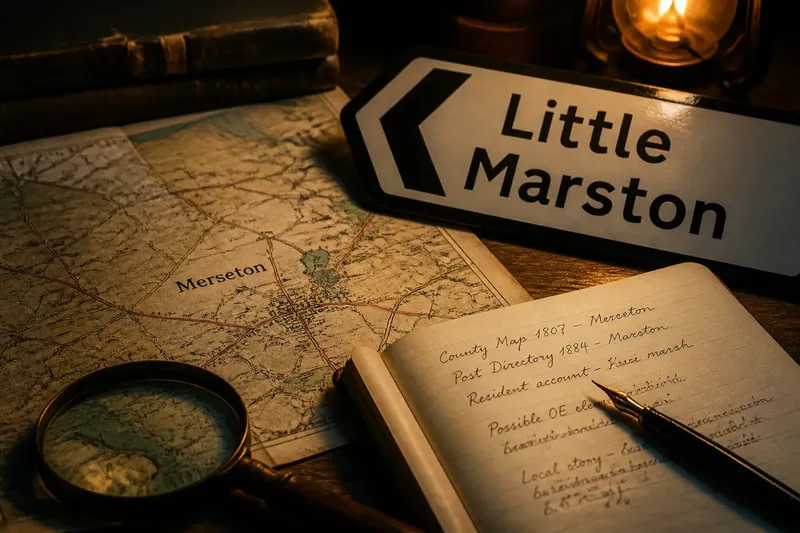
A road sign points toward Little Marston, while an older map labels the same spot “Merseton.” That difference is not a puzzle with one obvious answer. If you want to explore a place name, begin by separating what a source actually records from what its spelling might suggest and what someone later inferred.
This distinction matters in county geography because names travel through maps, deeds, directories, speech, and memory. Each preserves a different kind of evidence. A careful method lets you use those traces without asking a suggestive syllable to carry more certainty than it can bear.
Choose your starting point
Begin with the question you are trying to answer. Are you checking how a name was written, looking for a possible linguistic source, or assessing a familiar local explanation? Those are related tasks, but they call for different evidence and different language in your notes.
- For a spelling question: collect dated forms from maps, records, or local directories. This fits when your aim is to describe how the written name changed.
- For a language question: compare the name’s parts with relevant place-name dictionaries, language references, or specialist accounts. This fits when you want a cautious account of possible meaning.
- For a local story: trace where the explanation appears and whether it is tied to a source or a named tradition. This fits when you want to describe what residents say, not certify an origin.
- For an uncertain name: keep competing explanations separate and state what evidence is missing. This fits when neither the record nor the linguistic comparison settles the matter.
Say you are examining “Merseton.” You find that an old county map has that spelling, a later directory has “Marston,” and a resident recalls a story about a nearby marsh. The useful result is not “the place was named for the marsh.” It is a set of distinct observations: two recorded forms, a possible sound change to investigate, and a local explanation whose documentary history remains unknown.
Recorded forms
A recorded form is the spelling a particular source gives at a particular point in its own history. It does not automatically tell you how people pronounced the name, what they meant by it, or whether the spelling was customary beyond the document. Note the source and context beside each form rather than treating a list of spellings as a ready-made origin story.
Useful sources can include county maps, land records, parish or municipal documents, postal directories, gazetteers, and local historical collections. A map may be convenient, but its label could have been copied from earlier material. A deed may preserve a name in a legal description, while a directory may reflect the spelling used for addresses. Each source answers a limited question.
When you compare forms, preserve spelling, capitalization, punctuation, and any abbreviation as printed. Record the source’s title, the relevant location, and the date or edition if available. If the source is undated, say so; do not quietly assign it a year because it looks old.
Then ask whether two spellings refer to the same place. Nearby names can be confused, a settlement’s label can shift on a map, or a feature can share its name with a district. Check the surrounding entries, mapped features, and descriptions before treating a spelling as an earlier form of your target.
Possible language clues
Once the recorded forms are in order, consider linguistic clues. A place name may contain recognizable elements from a language used in the area, but resemblance alone is not enough. The proposed element should fit the name’s recorded forms and the language’s sound and spelling patterns, rather than merely matching a modern English word by eye.
Look at the whole form before dividing it into parts. A familiar ending can be misleading if it arose through later spelling, pronunciation, or copying. Likewise, an apparent first element may be a personal name, an older word, or simply a sequence that happens to resemble one.
Use references that identify their evidence and explain uncertainty. A county history may offer a useful lead, but a bare statement of meaning is not the same as a demonstrated derivation. Specialist place-name dictionaries and language references can help you assess whether a proposed element is plausible; they do not remove the need to check that the documented forms fit it.
Keep the wording proportionate. “The name may contain an element associated with…” signals a proposal. “The form is consistent with…” describes compatibility, not proof. If a source makes a firm claim but does not show its reasoning, attribute the claim to that source rather than adopting it as settled fact.
Stories and speculation
Local explanations deserve attention because they reveal how people understand a place and pass its identity along. They may also preserve a genuine memory. But a story’s familiarity does not establish that it explains the name’s origin, especially if it appears only in recent retellings or conflicts with older recorded forms.
Ask who tells the story, where it appears, and what it claims. A family account, a museum caption, a newspaper feature, and an anonymous online post are different kinds of evidence. None should be dismissed automatically, but each supports a different statement: that a story is remembered, that an institution presents it, or that a particular publication printed it.
Notice whether a story explains the name through a visible feature, a notable person, an event, or a word that sounds similar. These are common shapes for explanations, not evidence that they are false. They are reasons to check whether an older form or a reliable linguistic account supports the connection.
If a story cannot be verified, retain it as a story with clear attribution. “Local accounts connect the name with the marsh” is more accurate than “the name means marsh.” That distinction protects both the record and the value of the tradition: one can be uncertain about an origin without pretending nobody tells the story.
What fits your question?
What if I only need the historic spelling?
Use dated sources that refer clearly to the same place, and report the forms with their sources. You can describe a spelling sequence without claiming that it explains the name’s meaning.
What if two sources disagree?
Keep both readings, then inspect each source’s date, purpose, and location. A disagreement may reflect a copying error, a changing convention, or a different feature; it does not need to be resolved by choosing the more attractive spelling.
What if I have a convincing local story?
Record who shares it and where you encountered it, then look for older forms or independent support. If that support is absent, present the account as local tradition rather than as a confirmed derivation.
What if no explanation fits?
Say that the origin remains uncertain and identify what you checked. An incomplete answer is more useful than a confident guess because another reader can see where the evidence ends.
Keep the evidence visible
A compact working note can prevent later confusion. Separate the material into three headings: recorded forms, possible linguistic clues, and unverified explanations. Under each, write only what the source supports, with enough detail to find it again.
- Copy each spelling exactly as it appears.
- Identify the source and its date or edition, if known.
- Check that each form refers to the same settlement or feature.
- Mark linguistic proposals as possibilities unless their support is clear.
- Attribute stories to the people or publications that tell them.
- List unresolved questions rather than filling gaps with a guess.
These notes also help when sources use different names for nearby places. A county map might label a stream, a settlement, and a district with related forms. Keeping the location attached to each spelling prevents a plausible derivation for one feature from being borrowed for another.
Write the account carefully
When you share what you learned, lead with the evidence rather than the most entertaining explanation. A concise account can give the earliest form you located, mention later spellings, summarize the linguistic possibility, and distinguish any local story. If the earliest source you found is not necessarily the earliest form ever recorded, say “earliest form located” rather than “original name.”
For example, a careful note might say that one map records “Merseton,” a later directory gives “Marston,” and a local account connects the name with a nearby marsh. It could add that the proposed connection has not been confirmed by the forms examined. That wording leaves the reader with useful clues and an honest boundary around them.
For a place name, the most reliable account is often not the one with the neatest origin. It is the one that lets a reader see which parts come from records, which come from linguistic interpretation, and which remain part of local memory. That separation is the clue that keeps the rest in view.